Manual Handling Procedure
About a third of all reported accidents arise from manual handling, most of these accidents cause back injury, though hands, arms and feet are vulnerable. Many handling injuries build up over a period of time, rather than being caused by a single incident. To protect ourselves when performing manual handling operations, we need to apply good techniques:
What is manual handling?
It’s lifting and moving things by using your hands or bodily force. You need to learn the right way to lift and move things to help reduce the risk of accidents and injuries like these.
Strains and sprains
Muscles and joints can be injured if you do too much.
Fractures
Dropping a heavy load can break bones.
Wounds
Handling sharp, rough surfaces can cut and bruise your skin.
Hernias
The strain of lifting can cause painful ruptures in your stomach muscles.
Why do I need to know about manual handling?
Employers and employees share responsibility for preventing accidents and injuries.
Your employer’s responsibilities include the following.
- Carry out a risk assessment and providing mechanical aids where necessary.
- Providing information and training on safe systems of work,
- Providing supervision and guidance to make sure correct procedures are followed.
Your responsibilities include the following:
- Going on all training courses and using what you know at all times.
- Using the mechanical aids provided and following safe systems of work.
- Telling your employer about any medical conditions that could affect your ability to handle loads, for example
pregnancy, illness or injury.
- Reporting any hazards to your supervisor.
It takes a team effort to organise safe systems for manual handling. Do your part to reduce accidents and injury.
Prevent pain, injury and damage
Follow the basic tips to prevent accidents
Examine the object.
Check to see if the load is stable and equally distributed. Decide whether the object is likely to be too heavy to lift safely. Look for any sharp edges. Consider whether there is an alternative to manual handling. Check whether it can be divided into smaller loads.
Plan the job
Check with your supervisor or manager on a safe system of work. Check the route you will take for steps or other features you need to be aware of. Find out where the object will be unloaded and plan ‘rest stops’ along the way and between loads.
Get a good grip
Decide before hand how to hold the object. Protect your hands and feet by gripping the load firmly. If you wear gloves to prevent cuts or burns, make sure they fit properly and don’t slip.
Get help
Use the mechanical aids provided, and get help if you have any doubt about moving an object yourself.
Wear suitable clothing
- Your clothes should allow you to move freely but not be so loose they could snag or get in the way.
- Footwear should provide support and protection, be stable and have non-slip soles.
- If personal protective equipment (PPE) is needed, make sure it doesn’t interfere with your ability to handle loads safely. For example, make sure gloves fit well and allow you to have a firm grip.
Rest, or rotate tasks
Avoid becoming overtired. Frequent lifting lowering and moving is demanding work and can cause stress to the muscles and joints. Take short rests regularly and do other tasks between moving items if you can.
Ask for advice
Do not hesitate to discuss anything you aren’t sure about with your supervisor or manager.
Lift with your legs
Stand in comfortable position. Lift smoothly, keeping the load close to your body as you lift. Avoid lifts above your shoulders and below your knees – these put extra strain on your back.
Keep hands in the clear!
Be careful not to crush your fingers when you are putting things down.
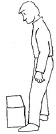
| 1. Stop and think. Plan the lift, where is the load going to be placed? Do you need help with the load? Remove obstructions such as discarded packing materials. |
 |
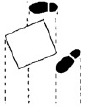
2. Place the feet. Feet apart, giving a balanced and stable base for lifting. Leading leg as far forward as is comfortable. |
 |
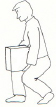
| 3. Adopt a good posture. Bend the knees, but do not kneel. Keep the back straight (tucking in the chin helps). Get a firm grip, a hook grip is less tiring than keeping the fingers straight./td>
|  |
4. Don’t jerk. Carry out the lifting movement smoothly, keeping control of the load. If it is necessary to vary the grip as the lift proceeds, do this as smoothly as possible. |
 |
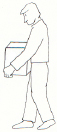
| 5. Move the feet. Don’t twist the body when turning to the side. Keep the load as close to the body as possible. |
 |
6. Put down, then adjust. If precise positioning of the load is necessary, put it down first, then slide it into position. |
 |
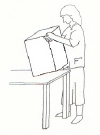
| 7. Unfamiliar loads, should be treated with caution. It should not be assumed that closed containers are empty. The load may be tested by attempting to raise one end. Apply force gradually. |
 |
8. If undue strain is felt, seek help. If team handling is required, you should seek assistance. There are no prizes for those who injure themselves. |
 |
Carrying
You can help to prevent injuries when carrying objects too. Here’s how:
- Don’t block your vision by carrying something that is too big. Use a mechanical aid or get help if you need
it.
- Keep your arms tucked in to prevent your neck and should muscles from getting tired or injured.
- Keep the load close to your body
- Don’t twist your body,stoop, bend or lean back. If you must change direction, move your feet instead.
- Don’t change your grip on the load unless its weight is supported.
- Face the spot where the load will rest by turning your feet and whole body in that direction.
Unloading
Be as careful setting down the load as you were when lifting it.
- Bend your knees to lower the load. Don’t stoop. Keep the load close to your body.
- Be careful with your fingers and toes. Make sure there is enough room for them when you put the load down.
- Put the load on a bench or table by resting it on the edge and pushing it forward with your arms and body.
- Slide the load if it needs to go into a tight space – it’s much easier and safer than trying to lift it.
- Make sure the load is secure wherever you place it. Make sure it won’t fall, tip over, roll or block someone’s way.
More tips for carrying and unloading things
- Don’t overdo it. For example, take two small loads instead of one big one. Get help for large objects, or use a trolley.
- Stack material carefully as you unload. Don’t stack things to high or try to balance material that might fall.
Special lifts
You may have to use different types of lift for some objects. Remember to always plan the task before you begin.
One handed lifting
If you need to lift using only one hand, for example when lifting a bucket, take extra care.
- Divide the load if you can.
- Brace your body with the opposite arm, if possible. This will steady and support your body.
- Reach for the load. Bend your knees and keep your back straight.
- Grip the load firmly (use a handle if possible)
- Lift with your legs, using your free arm for balance.
- Keep your shoulders level. Switch hands regularly.
If your load is heavy, large or awkward, you may need to work with one or more people.
- Work with others who are of similar build and height to you.
- Choose one person to give instructions.
- Make sure everyone has a good grip on the load.
- Lift from the hips at the same time, then raise the load to the right level.
- Move smoothly and at the same time.
Awkward objects
Some objects may be an unusual or difficult shape and size.
- Stand over one corner of the load, with your feet comfortably apart.
- Grasp the bottom inside and top outside corners.
- If the weight is unbalanced, lift and carry the object with its heaviest side close to your body.
- Bend your knees and lift, keeping the same grip.
Lifting to a high place
Try not to lift anything above your shoulders as it may put strain on your body.
- Lighten the load if you can by dividing it into smaller loads.
- Stand on something sturdy (not a chair) with one foot in front of the other, unless you are using a stepladder.
- Use a mechanical aid to get help if the load is awkward or heavy.
Lowering from a high place
Take extra care when you are lowering objects from above your head.
- Test the load’s weight by pushing up on it. Check to see if the weight of the load will shift when you lift it.
- Check to make sure there isn’t anything on top of the load that could fall off when you lift it.
- Stand as close to the load as possible.
- Grip the object firmly, sliding it down your body.
- Use a mechanical aid or get help if necessary.
Pushing and pulling safely
Use a truck or trolley to move large, heavy objects, and take care when pushing and pulling.
Don’t overload the truck or trolley. Make sure you can see over the top.
Stay close to the object and keep control over it’s movements. Take special care on slopes.
Get a good grip of the handle
Keep your elbows in and make sure your feet, fingers and clothing cannot get trapped or caught.
Lean in the direction you are pushing or pulling, keeping your back straight and knees slightly bent.
Watch out for obstructions and hazards such as uneven or slippery floor surfaces. Watch where you’re going! Whatever you move, make sure the route is clear and free of dangers that could cause a clip, trip or fall.
Special objects need special handling
Barrels, drums and kegs
Roll a heavy barrel if you move it by yourself, keeping one hand on it at all times to control its speed. If you must move it on its end, use a mechanical aid or get helps.
Boxes and cartons
Grip opposite bottom corners, and keep the object close to the middle of your body. Keep your arms as straight as possible.
Sacks
Carry the sack on your shoulder, supported by your hand on your hip. Or, hold it at opposite ends, resting the load against your hip and stomach. Get a good grip. Be extra careful if you are carrying slippery plastic sacks.
Learn how to lift and move things the right way and reduce the risk of back injuries, strains, sprains, cuts and bruises.
Take training seriously
Training is important to help you learn to move and lift properly. Put what you learn to good use.
Use safe systems
Your employer will provide safe systems of work and make sure you have enough supervision. The rules are there to protect you, so follow all your employer’s safety guidelines at all times.
Think about your fitness and health Make sure you are fit enough to do the job. Tell your supervisor or manager if you have any condition that could affect your ability to lift or move things, such as illness, pregnancy or injury.

