Working Together
Rules and regulations as such neither encourage enthusiasm nor maintain efficiency: what is important is their
intention, as well as the spirit of their interpretation and use. Nevertheless, when people are working together
as a community there must be certain agreed principles and lines of conduct so that the organisation can operate
smoothly in the best interests of everyone, including customers.
When you commence your placement with the Company it is understood that you accept these rules as conditions of
employment. Employees who disregard them can cause inconvenience, perhaps danger to fellow employees and interrupt
the work of the Company, and therefore, render themselves liable to disciplinary action.
Your manager/supervisor will give you working instructions and directions and will answer any questions associated
with your work or employment with the Company. You will work as a member of a team, and this will sometimes
involve duties other than those for which you are primarily employed.
The basic responsibilities of employees can be stated as follows:
- to work efficiently, conscientiously and safely;
- to produce workmanship to reasonably expected quality standards and procedures
- to care for the Company property;
- to observe strictly all rules and regulations relating to health and safety, and report to your
manager/supervisor any hazards to safe working arrangements;
- to use safety equipment and protective clothing where this is provided, and to wear appropriate clothing and
footwear;
- to refrain from interfering with any equipment or Company property;
- to observe strictly all rules and regulations relating to employment with the Company;
- to carry out all reasonable duties and instructions
- to maintain the image and reputation of the Company
Our constant endeavour is to promote, establish and maintain a firm foundation for harmonious working
relationships between the Company and its employees. It is the responsibility of managers and supervisors to plan,
organise and manage the operations of the business in the manner which will achieve maximum efficiency. Whilst at
work, the first responsibility of any employee is to his/her employment by the Company and therefore his/her job
must be his/her primary function.
Manner
You should be courteous, efficient and professional at all times when dealing with customers and other third parties,
whether in person, in writing or on the phone. You should never commit any act which may bring the company into
disrepute.
There are many visitors to the Company’s premises. All of them are important in that they view the Company through
their reception by and observation of the people on site.
SWIPE CARD PROCEDURE
For Health and Safety purposes you must swipe in on arrival for work and out at the end of the day as per the Swipe Card Procedure.
It is very important that if you forget your swipe card you inform Security prior to commencing work. They will issue you with a temporary pass.
You must only swipe your own card.
You must work until the end of their shift. No one should be waiting at the swipe machine prior to the end of their working period.
Fire Evacuation System (FES)
Swipe cards are colour coded for each site and MUST be with you at all times
RED – BURY
BLUE – HEAP BRIDGE
GREEN – GREENGATE
The swipe card system will record your presence on site for the Fire Evacuation System (FES). If the fire alarm sounds a roll call will automatically be printed in the security lodges of who is on site. Failure to comply with this instruction may result in the instigation of the Company’s Disciplinary procedure. It is extremely important that you adopt this procedure and respect the reasons behind its implementation. It could result in saving your life in the event of an emergency evacuation.
If you lose or forget your swipe card you must report it to security before you commence work. They will issue you with a day pass. This day pass must be handed into security if you leave site for any reason. Swipe Card Procedure Bevis Green & Heap Bridge
There are two swipe termianls
O
For monthly paid employees
X
For hourly paid employees
There are three lights on the terminals
Amber – terminal is active
Green – swipe has been successful, you will hear a Beep.
Red – error with swipe – please try again
If you are leaving site at the end of shift or for a personal appointment
Swipe out at the correct terminal.
If you are leaving site on Company Business
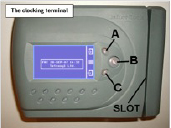
Prior to swiping push button A on the key pad then swipe out as normal.
If you are transferring to another site
Prior to swiping push button A on the key pad then swipe out as normal. Swipe in at the other site and follow the site transfer procedure again at the other site when leaving.
Time Management System TMS
Immediately after clocking in at the FES terminal proceed to the TMS terminal for your department.
Swipe in at the TMS terminal. You are now recorded as being in work for payroll purposes.
Dinner break -Swipe out at the TMS terminal. Swipe back in when you return to work.
If you are leaving site at the end of shift or for a personal appointment – Swipe out at the TMS terminal.
If you are leaving site on Company Business – Prior to swiping push transfer button C on the terminal then swipe out as normal.
If you are transferring to another site – Prior to swiping push transfer button C on the terminal then swipe out as normal. Swipe in at the other site and follow the site transfer procedure again at the other site when you return.
Swipe Card Procedure Greengate
Swipe your card through the slot on the terminal upon arrival at site.
If you are leaving site at the end of shift or for a personal appointment – Swipe out at the terminal.
If you are leaving site on Company Business – Prior to swiping push transfer button C on the terminal then swipe out as normal
If you are transferring to another site – Prior to swiping push transfer button C on the terminal then swipe out as normal. Swipe in at the other site and follow the site transfer procedure again at the other site when you return.
Mobile Phones/Personal Electronic Equipment
You are not allowed to use personal mobile phones, MP3 players or any other items of personal electronic equipment during your hours of work. Where necessary provide the direct dial number of either the branch or your Senior Manager or HR at Head Office to those individuals who may wish to contact you in emergencies. Personal calls being made or received should be kept to a minimum and permission should be sought from your Manager before making any outgoing calls. Failure to comply with the above may result in disciplinary action being taken.
Car Parking
The Company endeavours, wherever practicable, to provide some parking facilities for cars, However, the Company disclaims all liability, whether in negligence or otherwise, for loss of or damage to any vehicle and/or its contents whilst parked on the Company’s premises.
Right of Search
Theft of company property or the property of other employees is an offence. The company reserves and exercises the right to search any person on site or vehicle leaving the site.
PUNCTUALITY AND ATTENDANCE
You are expected to report for work punctually and to observe the normal hours of work laid including the provision for lunch breaks. Failure to report for work on time is detrimental to the efficient running of the business and imposes an unnecessary and unfair burden on colleagues.
You are responsible for ensuring you arrive at work early enough to enable you to begin work at your appointed start time. Your start time is the time you are expected to actually start work, not the time you are expected to arrive at your normal place of work. Likewise, you are required to remain at work and actually working at least until your appointed finish time, unless granted authorisation by your line manager to leave early. The same principles apply to lunch breaks.
If you are going to be late for work or absent due to sickness (or any other reason other than pre booked holidays), you must make every effort to contact your line manager by telephone as soon as possible to notify them of this fact and of the time you expect to arrive. If you are then late for work, you must report to your line manager and explain the reason for your lateness before starting work. It is expected that, occasionally, circumstances outside your control can cause lateness, for example cancelled trains or road traffic accidents. However, where the reason for delay is a normal or regular occurrence, or one which can reasonably be anticipated, this will not be regarded as a valid reason for your lateness, for example ongoing road works on your route to work.
If it becomes necessary for you to leave work before your normal finishing time or to take time off work during normal working hours (even in circumstances of a family emergency), prior authorisation must be obtained from your line manager. You must then report to your line manager on re-starting work.
Except in the normal course of your job duties and during your lunch break, you must not leave your place of work without prior authorisation from your line manager.
If you work 40 hours per week or over you are entitled to morning and afternoon breaks. These breaks are of 10 minutes duration and must be taken on Company premises and as agreed with your supervisor. In addition to the requirements on attendance records it is also considered bad timekeeping to abuse the break periods. All incidents of abuse will be treated in the same fashion as lateness and absenteeism.
Housekeeping
It is imperative that you adhere to departmental housekeeping regulations.
Consumption of Food and Beverages
Monday to Friday food and beverages may be obtained in the Canteen. Cold food such as sandwiches and fruit may be consumed in the Head Office and in office areas which are outside of and separate from manufacturing, warehousing and laboratory areas. For hygiene reasons on no account must food or food residue (peel etc.) be deposited in your office waste paper bins. Drinks are available from vending machines and microwaves are available. You are requested to use them with due care and consideration.
Partaking of food or refreshments in the manufacturing, warehousing and laboratory areas is strictly forbidden. Partaking of food or refreshments whilst walking round the site is strictly forbidden. Anyone seen eating outside of designated areas or dropping litter may be subject to action under the disciplinary procedure.
Mobile Phones/Personal Electronic Equipment
Personal calls being made or received should be kept to a minimum and permission should be sought from your Manager before making any outgoing calls. Personal mobile phones may not be used in warehousing, laboratory or production areas at any time.
Company Property
No Company property including merchandise of any description may be taken off the premises without your manager’s permission or unless accompanied with the appropriate documentation.
Dress and Appearance
You must adhere to the following minimum dress and appearance standards:
If your job does not bring you into contact with the Company’s clients or customers or members of the public, you are permitted to wear more casual clothing to work but the following are still classed as unacceptable attire for all employees:
- torn trousers
- shorts or miniskirts
- sports clothing, for example tracksuits and football shirts
- low cut or transparent tops
- tops with slogans or symbols that could cause offence
- trainers
- dirty clothing, or clothing in a poor state of repair
Jewellery policy for manufacturing and filling areas
This policy must be followed where there is a risk of jewellery, watches or personal clothing causing contamination of product. Jewellery must not be worn, with the exception of a single plain band ring and sleeper earrings (i.e. no stone settings and one piece). Cufflinks and tie pins must be considered as jewellery. Rings and studs in exposed parts of the body (such as noses, tongues and eyebrows) must not be worn. Watches must be securely fastened. Personal clothing should not pose a potential foreign body risk e.g. decorative items such as sequins should not be on garments.
Additional jewellery may be permitted if it is worn for medical or religious reasons. In these circumstances a risk assessment must be completed and the permitted jewellery must be strictly controlled. If you need to wear additional jewellery please inform your supervisor.
ABSENCE MANAGEMENT POLICY
You are expected to report for work punctually and to observe the normal hours of work as told t o you including the provision for lunch breaks. Failure to report for work on time is detrimental to the efficient running of the business and imposes an unnecessary and unfair burden on colleagues.
You are responsible for ensuring you arrive at work early enough to enable you to begin work at your appointed start time. Your start time is the time you are expected to actually start work, not the time you are expected to arrive at your normal place of work. Likewise, you are required to remain at work and actually working at least until your appointed finish time, unless granted authorisation by your line manager to leave early. The same principles apply to lunch breaks.
If you are going to be late for work or absent due to sickness (or any other reason other than pre booked holidays), you must make every effort to contact your line manager by telephone as soon as possible to notify them of this fact and of the time you expect to arrive. If you are then late for work, you must report to your line manager and explain the reason for your lateness before starting work. It is expected that, occasionally, circumstances outside your control can cause lateness, for example cancelled trains or road traffic accidents. However, where the reason for delay is a normal or regular occurrence, or one which can reasonably be anticipated, this will not be regarded as a valid reason for your lateness, for example ongoing road works on your route to work.
If it becomes necessary for you to leave work before your normal finishing time or to take time off work during normal working hours (even in circumstances of a family emergency), prior authorisation must be obtained from your line manager. You must then report to your line manager on re-starting work.
Except in the normal course of your job duties and during your lunch break, you must not leave your place of work without prior authorisation from your line manager.
DIGNITY AT WORK POLICY
The Company seeks to provide a work environment in which everyone is treated with respect and dignity and that is free of any form of bullying or harassment based upon age, disability, gender reassignment, race (including colour, nationality and ethnic or national origins), religion or belief, sex, sexual orientation (which are known as protected characteristics) or upon any other grounds.
You have a duty to co-operate with the Company to make sure that this policy is effective in preventing harassment or bullying. Action will be taken under the Company’s disciplinary procedure against any employee who is found to have committed an act of improper or unlawful harassment, bullying or intimidation. Serious breaches of this dignity at work policy will be treated as potential gross misconduct and could render the employee liable to summary dismissal. Employees should bear in mind that they can be held personally liable for any act of unlawful harassment. Employees who commit serious acts of harassment may also be guilty of a criminal offence.
All employees are responsible for conducting themselves in accordance with this policy. The Company will not condone or tolerate any form of harassment, bullying or intimidation, whether engaged in by employees or by outside third parties who do business with the Company, such as clients, customers, contractors and suppliers.
You should notify your line manager to suspected cases of harassment, bullying or intimidation. You must not victimise or retaliate against an employee who has made allegations or complaints of harassment or who has provided information about such harassment. Such behaviour will be treated as potential gross misconduct in accordance with the Company’s disciplinary procedure. You should support colleagues who suffer such treatment and are making a complaint.
The Company will also take appropriate action against any third parties who are found to have committed an act of improper or unlawful harassment, bullying or intimidation against its employees.
This policy covers harassment, bullying and intimidation both in the workplace and in any work-related setting outside the workplace, for example during business trips, at external training events or at work-related social events.
Bullying and harassment
Definitions
We regard abusive, violent or aggressive behaviour as any behaviour which produces damaging or hurtful effects, whether physically or emotionally, on an employee.
Bullying is offensive, insulting, malicious or intimidating behaviour or an abuse or misuse of power which undermines or humiliates an employee.
An employee unlawfully harasses another employee if
- they engage in unwanted conduct related to a protected characteristic
- that conduct has the purpose or effect of violating our employee’s dignity, or creating an intimidating, hostile, degrading, humiliating or offensive environment for them,
- that conduct is reasonably considered by the employee to have the effect of violating their dignity, or creating an intimidating, hostile, degrading, humiliating or offensive environment for them, even if that effect was not intentional.
- they engage in unwanted conduct of a sexual nature, and the conduct has the purpose or effect of violating the other employee’s dignity, or creating an intimidating, hostile, degrading, humiliating or offensive environment for that other employee.
Finally, an employee unlawfully harasses another employee if they or a third party engage in unwanted conduct of a sexual nature or that is related to gender reassignment or sex, the conduct has the purpose or effect of violating the other employee’s dignity, or creating an intimidating, hostile, degrading, humiliating or offensive environment for that other employee, and because of that other employee’s rejection of or submission to the conduct, they treat that other employee less favourably than they would treat them if they had not rejected, or submitted to, the conduct.
The unwanted conduct will still amount to harassment if it is based on the protected characteristic of a third party with whom the employee is associated and not on the employee’s own protected characteristic, or if it was directed at someone other than the employee, or even at nobody in particular, but they witnessed it. In addition, harassment can include cases where the unwanted conduct occurs because it is perceived that an employee has a particular protected characteristic, when in fact they do not.
The employee does not need to be the subject of the unwanted conduct for harassment to have occurred. For example, your conduct could be directed at someone other than the employee or even at nobody in particular.
Conduct may be harassment whether or not the person intended to offend. Something intended as a “joke” or as “office banter” may offend another person. This is because different employees find different levels of behaviour acceptable and everyone has the right to decide for themselves what behaviour they find acceptable to them.
Behaviour which a reasonable person would realise would be likely to offend an employee will always constitute harassment without the need for the employee having to make it clear that such behaviour is unacceptable, for example, touching someone in a sexual way. With other forms of behaviour, it may not always be clear in advance that it will offend a particular employee, for example, office banter and jokes or inviting an employee for a private drink. In these cases, the behaviour will constitute harassment if the conduct continues after the employee has made it clear, by their words or conduct, that such behaviour is unacceptable to him or her. A single incident can amount to harassment if it is sufficiently serious.
Examples
Examples of abusive, violent or aggressive behaviour include, but are not limited to, the following:
- verbal abuse, shouting or swearing
- physical assault, whether or not resulting in harm or injury
- assault using a weapon
- threat of harm to the employee, their property or their family.
Bullying and harassment may be verbal, non-verbal, written or physical and it includes conduct which takes place by telephone, e-mail, Facebook, video sharing sites, twitter etc and over the Internet in any other format. Examples of unacceptable behaviour include, but are not limited to, the following:
- unwelcome sexual advances, requests for sexual favours, other conduct of a sexual nature
- subjection to obscene or other sexually suggestive or racist comments or gestures, or other derogatory comments or gestures
- the offer of rewards for going along with sexual advances or threats for rejecting sexual advances
- jokes or pictures of a sexual, sexist or racial nature or which are otherwise derogatory
- demeaning comments about an employee’s appearance
- questions about an employee’s sex life
- the use of demeaning nicknames whether made orally or by e-mail picking on or ridiculing an employee
- the use of nicknames related to a protected characteristic because of a protected characteristic
- picking on or ridiculing an employee
- isolating an employee or excluding him or her from work related social activities or relevant work-related matters.
Reporting complaints
All allegations of harassment, bullying or intimidation will be dealt with seriously, confidentially and speedily. The Company will not ignore or treat lightly grievances or complaints of harassment from employees.
While the Company encourages employees who believe they are being harassed or bullied to notify the offender (by words or by conduct) that his or her behaviour is unwelcome, the Company also recognises that actual or perceived power and status disparities may make such confrontation impractical. In the event that such informal direct communication is either ineffective or impractical, or the situation is too serious to be dealt with informally, you should follow the procedure set out below.
If you wish to make a complaint of harassment, bullying or intimidation, whether against a fellow employee or a third party, such as a client, customer, contractor or supplier, you should follow the following steps:
- First of all, report the incident of harassment to your line manager. If you do not wish to speak to your line manager, you can instead speak to an alternative manager or to a member of the Human Resources Department on 0161 764 5981.
- Such reports should be made promptly so that investigation may proceed and any action taken expeditiously.
- All allegations of harassment will be taken seriously. The allegation will be promptly investigated and, as part of the investigatory process, you will be interviewed and asked to provide a written witness statement setting out the details of your complaint. Confidentiality will be maintained during the investigatory process to the extent that this is practical and appropriate in the circumstances. However, in order to effectively investigate an allegation, the Company must be able to determine the scope of the investigation and the individuals who should be informed of or interviewed about the allegation. For example, the identity of the complainant and the nature of the allegations must be revealed to the alleged harasser so that he or she is able to fairly respond to the allegations. The Company reserves the right to arrange for another manager to conduct the investigation other than the manager with whom you raised the matter.
- Once the investigation has been completed, you will be informed in writing of the outcome and the Company’s conclusions and decision as soon as possible. The Company is committed to taking appropriate action with respect to all complaints of harassment which are upheld. If appropriate, disciplinary proceedings will be brought against the alleged harasser.
- You will not be penalised for raising a complaint, even if it is not upheld, unless your complaint was both untrue and made in bad faith.
- If your complaint is upheld and the harasser remains in the Company’s employment, the Company will take all reasonable steps to ensure that you do not have to continue working alongside him or her if you do not wish to do so. The Company will discuss the options with you.
If your complaint is not upheld, arrangements will be made for you and the alleged harasser to continue or resume working and to repair working relationships. Alternatively, you may, if you wish, use the Company’s grievance procedure to make a complaint of harassment.
Disciplinary action
Any employee who is found to have harassed another employee in violation of this policy will be subject to disciplinary action under the Company’s disciplinary procedure. Such behaviour may be treated as gross misconduct and could render the employee liable to summary dismissal. In addition, line managers who had knowledge that such harassment had occurred in their departments but who had taken no action to eliminate it will also be subject to disciplinary action under the Company’s disciplinary procedure.
Any employee who requires advice or clarification on this policy should contact the HR Department on 0161 764 5981.
EQUAL OPPORTUNITIES POLICY
The Company is an equal opportunity employer and is fully committed to a policy of treating all of its employees and job applicants equally. The Company will avoid unlawful discrimination in all aspects of employment including recruitment and selection, promotion, transfer, opportunities for training, pay and benefits, other terms of employment, discipline, selection for redundancy and dismissal.
The Company will take all reasonable steps to employ, train and promote employees on the basis of their experience, abilities and qualifications without regard to age, disability, gender reassignment, marriage and civil partnership, pregnancy and maternity, race (including colour, nationality and ethnic or national origins), religion or belief, sex or sexual orientation. In this policy, these are known as the “protected characteristics”.
Employees have a duty to co-operate with the Company to make sure that this policy is effective in ensuring equal opportunities and in preventing discrimination. Action will be taken under the Company’s disciplinary procedure against any employee who is found to have committed an act of improper or unlawful discrimination. Serious breaches of this equal opportunities policy will be treated as potential gross misconduct and could render the employee liable to summary dismissal. Employees should bear in mind that they can be held personally liable for any act of unlawful discrimination.
You should draw the attention of your line manager to suspected discriminatory acts or practices.
You must not victimise or retaliate against an employee who has made allegations or complaints of discrimination or who has provided information about such discrimination. Such behaviour will be treated as potential gross misconduct in accordance with the Company’s disciplinary procedure.
You should support colleagues who suffer such treatment and are making a complaint.
The Company has a separate dignity at work policy which deals with harassment, bullying and intimidation and sets out how complaints of that type will be dealt with.
Direct discrimination
Direct discrimination occurs when, because of one of the protected characteristics, a job applicant or an employee is treated less favourably than other job applicants or employees are treated or would be treated.
The treatment will still amount to direct discrimination even if it is based on the protected characteristic of a third party with whom the job applicant or employee is associated and not on the job applicant’s or employee’s own protected characteristic. In addition, it can include cases where it is perceived that a job applicant or an employee has a particular protected characteristic when in fact they do not.
The Company will take all reasonable steps to eliminate direct discrimination in all aspects of employment.
Indirect discrimination
Indirect discrimination is treatment that may be equal in the sense that it applies to all job applicants or employees but which is discriminatory in its effect on, for example, one particular sex or racial group.
Indirect discrimination occurs when there is applied to the job applicant or employee a provision, criterion or practice (PCP) which is discriminatory in relation to a protected characteristic of the job applicant’s or employee’s. A PCP is discriminatory in relation to a protected characteristic of the job applicant’s or employee’s if:
- it is applied, or would be applied, to persons with whom the job applicant or employee does not share the protected characteristic
- the PCP puts, or would put, persons with whom the job applicant or employee shares the protected characteristic at a particular disadvantage when compared with persons with whom the job applicant or employee does not share it
- it puts, or would put, the job applicant or employee at that disadvantage, and
- it cannot be shown by the Company to be a proportionate means of achieving a legitimate aim.
The Company will take all reasonable steps to eliminate indirect discrimination in all aspects of employment.
Recruitment, advertising and selection
The recruitment process will be conducted in such a way as to result in the selection of the most suitable person for the job in terms of relevant experience, abilities and qualifications. The Company is committed to applying its equal opportunities policy at all stages of recruitment and selection.
Advertisements will aim to positively encourage applications from all suitably qualified and experienced people. When advertising job vacancies, in order to attract applications from all sections of the community, the Company will, as far as reasonably practicable:
- Ensure advertisements are not confined to those areas or publications which would exclude or disproportionately reduce the numbers of applicants with a particular protected characteristic.
- Avoid setting any unnecessary provisions or criteria which would exclude a higher proportion of applicants with a particular protected characteristic.
Where vacancies may be filled by promotion or transfer, they will be published to all eligible employees in such a way that they do not restrict applications from employees with a particular protected characteristic.
However, where, having regard to the nature and context of the work, having a particular protected characteristic is an occupational requirement and that occupational requirement is a proportionate means of achieving a legitimate aim, the Company will apply that requirement to the job role and this may therefore be specified in the advertisement.
The selection process will be carried out consistently for all jobs at all levels. All applications will be processed in the same way. The staff responsible for short-listing, interviewing and selecting candidates will be clearly informed of the selection criteria and of the need for their consistent application. Person specifications and job descriptions will be limited to those requirements that are necessary for the effective performance of the job. Wherever possible, all applicants will be interviewed by at least two interviewers and all questions asked of the applicants will relate to the requirements of the job. The selection of new staff will be based on the job requirements and the individual’s suitability and ability to do, or to train for, the job in question.
With disabled job applicants, the Company will have regard to its duty to make reasonable adjustments to work provisions, criteria and practices or to physical features of work premises or to provide auxiliary aids or services in order to ensure that the disabled person is not placed at a substantial disadvantage in comparison with persons who are not disabled.
If it is necessary to assess whether personal circumstances will affect the performance of the job (for example, if the job involves unsociable hours or extensive travel), this will be discussed objectively, without detailed questions based on assumptions about any of the protected characteristics.
Where a promotional system is in operation, it will not be discriminatory and it will be checked from time to time to assess how it is working in practice. When a group of workers who predominantly have a particular protected characteristic appear to be excluded from access to promotion, transfer and training and to other benefits, the promotional system will be reviewed to ensure there is no unlawful discrimination.
Terms of employment, benefits, facilities and services
All terms of employment, benefits, facilities and services will be reviewed from time to time, in order to ensure that there is no unlawful direct or indirect discrimination because of one or more of the protected characteristics.
Equal pay and equality of terms
The Company is committed to equal pay and equality of terms in employment. It believes its male and female employees should receive equal pay where they are carrying out like work, work rated as equivalent or work of equal value. In order to achieve this, the Company will endeavour to maintain a pay system that is transparent, free from bias and based on objective criteria.
Reporting complaints
All allegations of discrimination will be dealt with seriously, confidentially and speedily. The Company will not ignore or treat lightly grievances or complaints of unlawful discrimination from employees.
If you wish to make a complaint of discrimination, you should do so promptly and use the Company’s grievance procedure.
If your complaint relates to bullying, harassment or intimidation, you should refer to the Company’s dignity at work policy.
Any employee who requires advice or clarification on this policy should contact the HR Department on 0161 764 5981.
Supplier Ethical Data Exchange
Tetrosyl is a member of Sedex, the Supplier Ethical Data Exchange, and is committed to continuous improvement of the ethical performance of their supply chains. As such Tetrosyl is committed to the implementation of the ETI Base Code, a copy of the code can be found on your notice board.
Fair Working Conditions (FWC)
Tetrosyl is approved by FWC who are a non profit organisation who measure and formally accredit best employment practices.
HEALTH AND SAFETY
Copies of the Company’s Health and Safety, Environmental and Quality Policies can be found on the Company notice boards and in the relevant manuals. They can also be obtained from the Health and Safety Department.
You should comply with the Company’s Health and Safety Policies and Procedures at all times.
You are reminded, however, that everyone is required to have regard for the safety and well-being of themselves and others at work. You must report potential hazards, dangerous occurrences and accidents to your supervisor and co-operate with any investigations into accidents or dangerous occurrences.
At all times behave in a sensible and mature manner. Running, horseplay and practical jokes can cause accidents and injury. Any offence will be dealt with under the disciplinary procedure and could result in dismissal.
Prohibition on alcohol and drug consumption in the workplace
No alcohol or drugs must be brought onto or consumed on Company premises at any time or whilst attending any training courses, whether internal or external. Staff must never drink alcohol or take drugs if they are required to drive private or Company vehicles on Company business.
Social drinking after normal working hours and away from the Company’s premises is, of course, generally a personal matter and does not directly concern the Company. The Company’s concern only arises when, because of the pattern or amount of drink involved, the employee’s attendance, work performance or conduct at work deteriorates.
Smoking Policy
The right of people to breathe clean air prevails over the right of the smoker to smoke. Appropriate ‘no-smoking’ signs will be clearly displayed at the entrances to and within the premises, and in all smokefree vehicles.
Smoking (including both tobacco and electronic cigarettes, cigars, pipes etc) is not allowed in any Company or private vehicles or any part of the premises or grounds (including the car parks) on any site except for designated smoking shelters.
Accidents and Incidents
First Aid posters are positioned around Company premises and will inform you of the procedure to follow if you need a first aider. You are advised to have treatment for any injury sustained no matter how slight it may appear.
Fire Routine
You must be familiar with fire evacuation procedure and be aware of your assembly point. Full training on commencement of placement is given.
Equipment
Although not unusually dangerous, all office machines, PC’s V.D.U’s, photocopiers etc. should be treated with care and used in accordance with instructions.
YOU MUST NOT: –
- • Attempt to change or repair electric plugs, fuses, leads or machines, broken or loose connections*
- Use any machine which is faulty, nor attempt any repair*
- Attempt to clean electric equipment*
- Trail wire between desks along the floor
- Move Computer equipment. The I.T. Department must be notified in all cases
- Bring in electric fans or any other type of electrical appliance from home.
*unless employed as a qualified electrician by the Company
Lifting and Carrying
You will be trained in manual handling and this instruction must be strictly adhered to.
REVIEW OF RULES
These site rules will be kept under review and may be amended by addition, deletion or alteration in light of legislation and experience. This issue April 2015 supersedes all previous Tetrosyl site rules.

